
Transcending Misapprehensions / Michael Mobasheri-Germany


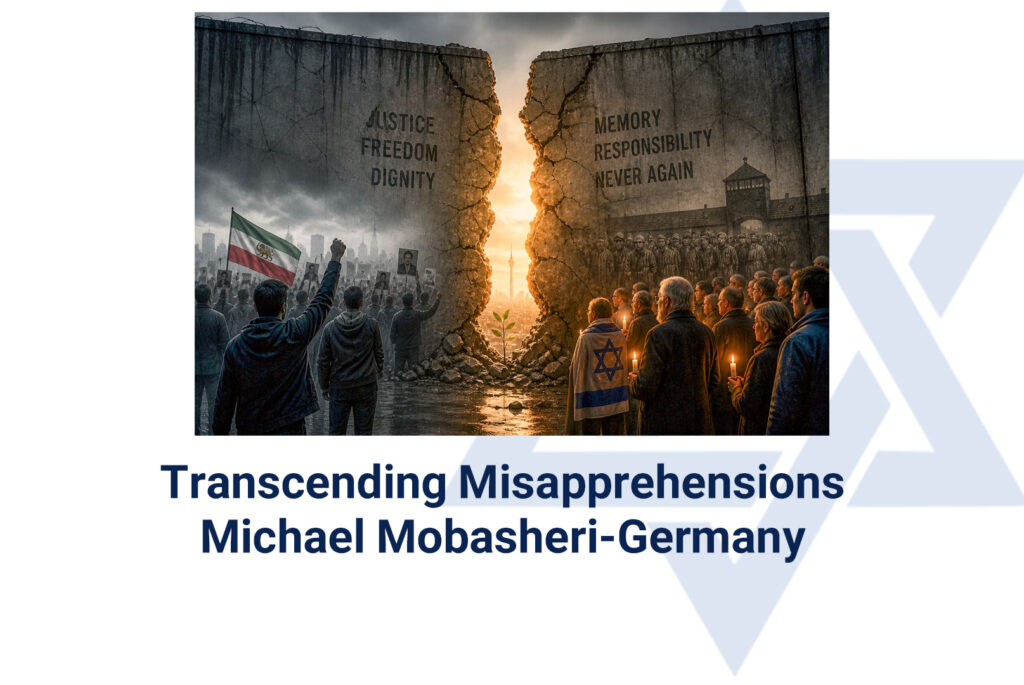
In January 2026, thousands of Iranians in exile—especially in cities like Los Angeles, New York, and
across Europe— marched to highlight the horrifying scale of the regime’s brutality, including the
killing of civilians and the arbitrary execution of wounded individuals left bleeding in the streets.
Reports also describe execution of the wounded protesters being transported to hospitals by
headshots inflicted by regime military personnel, including members of the IRGC and associated
paramilitary forces name Basij-militia. In addition, authorities have refused to return the bodies of
victims to their families without demanding payment (right up to 7000$) for each bullet used by the
regime to kill them. As many families cannot afford these payments, numerous bodies are reportedly
buried in unmarked mass graves after their organs are stolen by the regime, intended for sale on the
black market; While these events remain underreported and largely ignored in Western media, the
international community has shown a degree of superficial solidarity with the Iranian opposition but
has largely failed to reflect the full scale of brutality and severity of the regime’s crimes, as well as
the ongoing wave of politically motivated arrests and executions of Iranians to date.
The Iranian diaspora in exile, drawing on its experience over the past 48 years of Western
appeasement policies toward the regime, has responded by attempting to translate these atrocities
through metaphors, analogies and parallels with historical events that are deeply embedded in
Western—particularly European— collective memory. As a result, terms such as “genocide” and
“Holocaust” quickly regained attention due to their profound historical weight and significance.
These associations were intended to convey both the scale and the nature of the violence, drawing
parallels between the regime’s mentality and that of Nazi Germany in order to communicate the
extent of the atrocities to a global audience, especially the global-west states. Mehdi Yarahi, a lesser-
known Iranian music artist, released a music video titled “Auschwitz” to honor the memory of over
40,000 victims of the January 8–9, 2026 massacre.[1] At the Munich Security Conference(2026), U.S.
Senator Lindsey Graham drew a notable parallel between the two fascist Nazis regime and theocratic
Mullah-Regime, warning of the generational consequences and historical implications of U.S. and
European actions —without explicitly using the terms “genocide” or “Holocaust.”[2] However, the
use of these terms during Iranian diaspora rallies has led to misunderstandings and growing
irritation, particularly within Jewish communities in Europe and Germany. Due to the abuse of these
terms, this reaction is comprehensible and fairly legitimate, as both “genocide” and “Holocaust” have
frequently been misused in socio-political and academic discourses over previous decades —often
contributing to generalize and downplay holocaust. As a result, their use can evoke strong negative
associations and feelings, regardless of the context.
It is therefore crucial to clearly explain both the comparison and the use of the terms by the Iranian
diaspora in order to maintain mutual understanding and prevent further misapprehension with
Jewish communities. Failing to do so, risks creating unnecessary tensions and placing a lasting burden
on the Jewish-Iranian relations, which are expected to experience renewal and improvement
following the downfall of the current regime.
֍֍֍
The Iranian side needs to consider that the German term Holocaust-Relativierung -engl.: Holocaust
distortion or Holocaust trivialization- is a form of holocaust denial and historical revisionism in favor
of Antisemitsm that seeks to generalize, downplay, excuse, or equate the uniqueness, scale, or
responsibility for the Nazi crimes of genocide and Holocaust -especially annihilation of the Jews- with
other crimes. Holocaust trivialization/relativisation serves a dual function, at the center of which is an
antisemitic “reversal of perpetrator and victim” since conspiracy theorists portray offenders as
victims while defaming political opponents as Nazis and fascists, a Method used to blur the historical
facts and fake narratives to demonize Jews and undermine legitimate debate within a rational
framework; on the other hand, such comparisons relativize the actual crimes and horrors of the Nazi
dictatorship and their ideology because the antisemitic extermination policies are infamously
instrumentalized to downplay the scale of Holocaust as one of the most dreadful crimes in modern
history(a revisionist relativization of the Shoah).
The Jewish community needs to realize and take into account the specific transformations,
underlying backgrounds and key aspects of Iranian society and factual motivation behind this action.
First, it is indispensable to consider central transformations within the Iranian society regarding
regime’s actions. Over the past two decades, Iranian society has increasingly begun to resist the
regime’s ideology including its sheer Antisemitism, Israel-hatred and anti-Americanism. Many
Iranians have refused to comply with symbolic acts imposed by the regime, such as burning or
walking over Israeli and U.S. flags painted at the entrances of universities and public spaces.[3] For
nearly two decades, Iranians also have been chanting “Neither Gaza nor Lebanon, I sacrifice my life
for Iran” in the streets; This slogan reflects a fundamental opposition to the regime’s policies and
articulates a clear summon to prioritize Iran’s people and national interests over financing muslim
nations, while also expressing strong contempt and rejection of the regime’s backing of terrorist
organizations such as Hamas, Hezbollah, and the Houthis who widely pose an existential threats to
Israel and the Jewish nation. This marked the beginning of broader civil disobedience, reflecting not
only opposition to the regime itself but also a scorn of one the main pillars of the Islamic regime
namely Anti-Americanism and Antisemitism. What also remains deeply embedded in the Iranian
collective memory are the account of the Persian Empire under Kyros the Great, who freed the
Jewish people from their Babylonian captivity in 538/39 BCE, protecting some of Holocaust victims by
Iran especially “Children of Tehran” when holocaust was taking place(1942), while acknowledging
Holocaust as one of the most horrific crimes as well as widely condemned international caricature
contests promoting Holocaust denial and –relativization and creation of a ring of fire around Israel by
the regime(intensified since 2005 and picked by 2015), which would be met with clear declination
and contempt by much of the population in an upward trend. After all the term “Genocide” is not
restricted to cataclysm of holocaust and the Jewish history.
Second, It is essential to understand that the use of terms such as “genocide,” “Auschwitz,” and
“Holocaust” by the Iranian diaspora when describing regime violence must be interpreted through
both a cultural and linguistic perspective.
In particular, the meaning and translation of the term “genocide” into Persian differs in nuance from
its meaning in Western languages. The word itself originates from Génos(Greek-Latin, referring to
race, tribe, racial lineage, genetic and racial belongingness) and the suffix -cidium(derived from Latin
caedere, meaning to kill, cut, destroy). In Persian, “genocide” is translated as “Nasl-koshi”— “Nasl”
meaning “Generation”, and “koshi” meaning “the act of killing” and thus conceptualized literally
“killing of a generation” and as a result, the term carries a different conceptual weight. While in
Western contexts “genocide” is closely tied to race, ethnicity, and religion, in Persian it is understood
more broadly as the deliberate destruction and interpreted merely as systematic mass killing,
independent of racial classification. A literal equivalent in Persian language reflecting “racial killing”
would be “Gen–Koshi” or “Nedjad-koshi,” (GEN and NEDJAD refer to Genetic & race or tribal
belongingness), yet a literal one-to-one race-based equivalent for “Genocide” (i.e. race-killing) does
not exist linguistically in Persian and would sound very unusual and strange to Iranians. Thus in
linguistic context, the Persian word “Nasl-koshi” does not carry the same emphasis on race-based
eradication, nor is it seeking to downplay or abuse the suffering of genocide- and holocaust victims
for a revisionist or political reasons. Consequently, when members of the Iranian diaspora use terms
like “genocide” or “Holocaust,” they are primarily referring to the systematic destruction of
generations —particularly the targeting of younger populations—rather than invoking the strict
Western legal or historical definition. This language also reflects an attempt to convey urgency and
draw attention to what is perceived as insufficient international response.
In a cultural context, Iranian culture and the Persian civilisation do not traditionally conceptualize
humanity through rigid genetic, racial or tribal distinctions or classification like the European cultures
do; such categorizations are more closely associated with European historical frameworks of race
and racial ideologies. This distinction is further shaped by the fact that Persian civilisation
philosophically and historically places the emphasis on viewing humanity as a unified whole and a
homologous entity in creation. This humanistic and altruistic view is also excellently reflected in the
Iranian literature and Poetry as Saadi Shirazi(1210-1291) expresses powerfully in his prose-
masterpiece name “Human Beings” –also known as “Sons of Adam”:
Human Beings are members of a whole In creation of one essence and soul
If one member is inflicted with pain Other members uneasy will remain
If you have no sympathy for human pain The name of human you can not pertain
Third, it needs to be emphasized that the regime’s Islamic ideology fundamentally rejects key
elements of Persian civilization which is rooted in natural laws, glorification of life and humanistic
philosophy. Regimes Islamic Ideology is in contrary grounded in Islamic Sharia law, glorification of
death and the promotion of an apocalyptic death-cult, Antisemitism, Anti-Modernism and with it
Anti-human mindset, that constitutes another central pillar of the Islamic Republic’s system of
governance. By denying and vigorous endeavours to eradicate Iranian culture, its rich pre-Islamic
history and record of the Persian civilisation, the regime has fundamentally insulted Iranian identity
and civilization multiple times which outraged many Iranians. As a result, many Iranians meanwhile
perceive Islam and the regime as the arch-enemy and principal adversary of Iranian identity and
Persian civilization, standing in direct opposition to longstanding Persian values such as tolerance,
peaceful coexistence and “cultural mosaic model” of universal inclusion, integrity and integration.
This perception has been articulated by considerable majority of Iranian civil society and echoed by
Crown Prince Reza Pahlavi over and over again in reciprocity; Reza Pahlavi’s statement captures this
sentiment and transformation perfectly when he states: “The Islamic republic regime is not the
government of Iran, it is a hostile occupying force that has hijacked our homeland… using foreign
terrorists and mercenaries to slaughter the Iranian people… this is no longer mere repression, this is
foreign occupation… the battle in Iran today is not between reform and revolution, it is between
occupation and liberation… the end of this regime will mark the rebirth of one of the most
accomplished civilizations [Persian civilization] in history.”[4]
This marks yet another significant transformation in the contemporary Iranian history and collective
consciousness.
Forth, referring to the recent massacre in Iran using terms “genocide” and “Holocaust” underscores a
fundamental distinction between the Iranian people and the regime: While the regime denies the
Holocaust and the genocide of Jews, intends to annihilate Israel and undertakes plans to another
Holocaust against the Jews, many Iranians firmly reject this offensive attitude by explicitly
acknowledging and evoking holocaust and the true character of this regime as an adversary. By
recognizing the Holocaust as one of the gravest crimes in human history, Iranians are actually
expressing solidarity with its victims —particularly the Jewish community— while simultaneously
condemning the regime’s fascistic dominance aspirations. This is most clearly demonstrated when
Iranians carry and wave U.S. and Israeli flags alongside the Iranian Lion & Sun flag at their rallies,
indicating respect and support for both Iranian compatriots in Iran and Israel –including Holocaust
victims– to convey a message of unity and credit to Jews who know the burden of Genocide and
holocaust. The persecution and systematic murder of Jews were driven by a pseudoscientific racial
ideology rooted in so-called “racial hygiene and eugenics”, fuelled by a psychotic obsession for racial
purity. By contrast, the killing of tens of thousands of Iranians in the context of protests against the
Islamic regime stems from an Iranian renaissance that opposes a destructive theocratic state, and
resistance to an imposed ideology, Islamic occupation and a deep desire for freedom.
Albert Bootehsaz, the Persian-American political analyst and a Board Member of the
NoToAntisemitism.org organization in Los Angeles, with Persian-Jewish heritage, endorses the
arguments presented in this essay that articulates the Iranian perspective, striving to provide
nuanced explanations rather than mere justifications refarding term usages in Danti regime
demonstrations in diaspora. Exchanges of perspectives and considerations by both sides are essential
to establishing a common ground built on mutual respect and recognition. This foundation will not
only strengthen bonds of friendship between two nations of Irqan and Israel but will also be crucial
for the future alliance and cooperation to protect Iranians and Israelis from shared enemies and
create a better future for upcoming generation.
References
[1] Mehdi Yarahi – Auschwitz(Official Video Feb.2026) https://www.youtube.com/watch?v=bWMz- and also
https://www.instagram.com/reel/DUnsIZngRMZ/ [2] Sen Lindsey Graham(MSC, 2026)
https://www.youtube.com/watch?v=H6xBeD19SfU [3] VOA Farsi (2020):
https://www.youtube.com/watch?v=IwOw86gP6hA , Isfehan University entrance(2019):
https://www.youtube.com/shorts/ZXXGRLrOqPY and also https://www.youtube.com/watch?v=MFoBxq2AeD0 , [4] Iran’s
exiled crown prince Reza Pahlavi, Press Conference in Washington (Feb. 2026)