
Schattenarmee: Arabisch-Palaestinensische Kooperation mit dem Zionismus, 1917–1948


Book Review
By: Michael Mobasheri
First published in German language by Israeli-German online Magazine haGalil.com (June 2026)
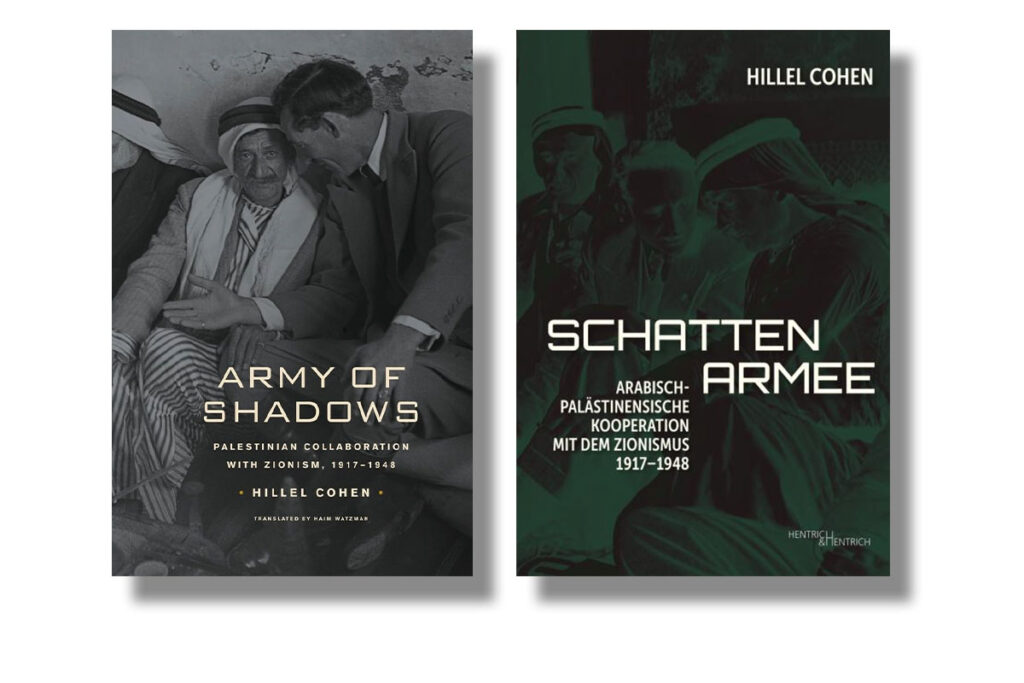
In May 2026, the German translation of the fascinating book by Israeli scholar Hillel Cohen “Schattenarmee: Arabisch-Palästinensische Kooperation mit dem Zionismus, 1917–1948” (Engl. “Army of Shadows: Palestinian Collaboration with Zionism, 1917–1948”) was published in Germany; a book that was received with fierce controversy and also great acclaim in Israel. The Author draws on a wide array of multilingual archival sources –including, Hebrew, Arabic and English– to provide a structured academic work and a balanced analysis of Arab-Palestinian Nationalism as well as Arab collaboration and warfare with Zionist movement during the British Mandate era, up to Arab-Israeli-War 1948. The book presents an approach rooted in “history from below”, moving beyond the elite level to demonstrate the scope and features of interactions between the Arab and Yishuv communities and raises important questions about the origins and formation of Arab nationalism—thereby offering perspectives that also shed light on the contemporary situation.
H.Cohen presents Palestinian Arab nationalism that is deeply rooted in tribalism and religion, yet shaped by a persistent interplay between claims to religious legitimacy and pragmatism —and at times, opportunism and rivalry. The Author describes how this constellation impacted adoption of “collaboration” and conception of “nationalism” in the Palestinian-Arab Population. H.Cohen portrays events that have deliberately remained unattended and contrasts the two appearances of nationalism, suggesting that Zionists hesitate to recount the history of Arab collaboration because doing so would support the claim of a universal, uncompromising and relentless Arab animosity toward the Yishuv and Zionism, whereas Palestinians do not tell the story because they need to sustain a retrospectively constructed national identity in order to compensate for their collapse in the face of deep internal fragmentation, lack of consensus on collective identity, fiasco of Pan-Arab Nationalism, and reluctance to acknowledge the legitimacy of Jewish and Zionist claims and historical presence in the region.
By engaging with complex socio-political processes and chain of historical dynamics, Cohen makes a significant contribution to the study of Palestinian history, society, and its political landscape. The book provides insight into how the Arab population has conceptualized “nationalism” and “treason”, shaped by different players —from urban elites to rural and tribal communities— competing for power, profit and control. The book illustrates diverse political and conceptual facets of Arab-Palestinian-Nationalism, which led to fragmentation and displacement of Palestinian-Arab society and sheds a new light on the origins of Nakba, in convergence of broader transformations in the Arab-Palestinian community within their historical and sociocultural contexts —contexts that are inevitable for understanding both internal Palestinian conflict as well as the Palestinian–Israeli conflict. Notably, many patterns of action portrayed in the book remain recognizable also today.
This book specially presents a categorization of Arab-Palestinian community along socio-political and tribal-rooted attitudes, describing motivations that led some Palestinians to cooperate with the Zionists, including occupational impetus driven by social status attainment, feud & vendetta as well as political, economical, intelligence- & military collaborations. The book reveals that Arabs worked as informants, sold land to Jews, supplied weapons and formed personal alliances with Jewish neighbors and settlements, while providing a contextual portray of how such collaborations were utilized by the Zionist movement —also to penetrate and undermine segments of the Arab community and weaken the national alignment— and how it may have contributed to Zionism’s growing influence and acquisition of land, overcoming Arab’s utter resistance against the still-emerging Zionist project, which sought to consolidate the foundations of the Jewish state following the Balfour-Declaration; Cohen also emphasizes that on several occasions, the Zionists concealed their true intentions and took advantage of Arab collaborators to achieve their goals. However, in some cases, Zionists were obliging and consequently compensated collaborators. Thus one of the fascinating characteristics of Hillel Cohen’s book is the author’s endeavour to remain impartial and fair, deliberately leaving “the moral and political judgment” to the reader while offering an authentic and nuanced picture of the political landscape during the British Mandate period.
Furthermore, the book demonstrably provides a detailed account of the synthesis of Arab nationalism with religion(Sharia), which adamantly enforced religious decrees(Fatwa) to defy and repel the Zionist movement; It highlights that members of other opposition Arab nationalist-factions that engaged with Zionist institutions or Jews were suppressed and slandered as “traitors” by the religious faction. Cumulatively this religiously infused nationalist framework emerged as the predominant Arab nationalist institution and the main opponent of the Zionist project, reinforced by anti-Zionist propaganda and implementation of calls for boycott of Jewish merchandise and Jewish institutions(identical to the BDS movement in our time) igniting episodes of violent riots, plunder and massacre of Jews and dissidents. The challenges Zionists faced, the strategies and institutional development of Jewish political- and security structures are comparatively mentioned both in historical and socio-political context. The book elucidates that the Zionist movement ultimately resorted to militant and counterintelligence measures in response to increasing hostility from militant Arab groups attacking Jewish settlements.
The instrumentalization of the Arab-Palestinian press and mobilization of mosques are highlighted as key mechanisms in shaping public opinion and advancing political objectives. The author further describes how these dynamics contributed to intimidation, demonization and social exclusion of Arabs who maintained transaction and engaged in cooperation with Jewish actors, often stigmatizing and despising them as “traitors to Palestinian Nation”, “Archenemies of Islam” and “heretics”. In this milieu, the concepts of “coexistence” became associated with “betrayal and espionage” and “cooperation” with the Zionist movement increasingly became a synonym for “collaboration and treason”. According to the book, this tactic served to legitimize bigotry, social sanctions, and segregation within Arab-Palestinian society and functioned not only as a tool of anti-Jewish agitation but also as an internal political strategy aimed at dictating new norms of a new political order while facilitating an instrument to denounce rival factions and discredit political opponents –while legitimizing terrorist militant methods for persecution and assassin, which amplified especially after 1934/35. This approach contributed tremendously to polarization and division which harmed the process of national unity.
The book contends that, in this atmosphere, the abstract concept of Arab-Palestinian nationalism gradually transformed, acquiring a pronounced ethno-religious dimension. As a result, antagonism to Zionism and to Arabs who maintained ties with Zionists became increasingly construed not only as a political stance but also as a religious obligation and a divinely sanctioned duty.
Cohen notes that one of the main figures in this process was Hajj Mohammad Amin al-Husseini(Grand Mufti of Jerusalem, head of the Supreme Muslim Council and the Higher Arab Committee) who applied such tactics to Palestinian–Arabs who dared to reject or even criticize him –regardless of their class, social standing or nationalist credentials; The terrorists looted, extorted, robbed, and murdered even their own people—with his knowledge and approval. Despite deploying such tactics to take over power and win hegemonic control, the Nationalist-al-Husseni-Faction acted hypocritically and interacted occasionally with Zionists whenever it served its economic and political interests —even if this came at the expense of the Arab population and national unity. Next to tribal mentality of Arabs, Cohen identifies al-Hussein’s leadership of the national movement as one of the key factors that undermined the formation of a broad Arab-Palestinian national consensus, finally contributing to its demolition and subsequent uprooting of Palestinian-Arabs, following escalation of the first Arab-Israeli war(1948).
The acclamation and enthusiasm of Hajj Amin Al-Husseini for the utter anti-Zionist ideology and antisemitic practices of the Nazis did not come about by chance and soon after turned into a significant mutual ground for cooperation, leading to close bilateral interactions against the Jews and the Zionist movement. However the Arab interface with Nazis was not merely a simple empathy and went beyond a pragmatic alliance: it was a deep ideological convergence and a fusion between two forms of toxic nationalist extremism; a fusion that has impacted the Arab Palestinian society and the entire Region ever since: on one side the “Islamic Arab-Palestinian Nationalism” based on Islamic-Jihadist anti-Zionism and on the other side the psychotic “Nazi Racial Nationalism” rooted in apocalyptic eliminatory anti-Zionism and delusion of “Racial-Purity.” Within their frameworks, both fascist ideologies portray Jews and Zionism as a central global antagonism and obsessively undertake their complete annihilation. Ultimately the concept of the Arab nationalism became subjugated by this religious-nationalist mainstream and its ideological convergence with Nazism had lasting consequences for the entire Middle East, contributing to the growing dominance of a more rigid, fundamentalist Jihadist interpretation of Arab nationalism and the definition of an “Islamic National identity.” This aspect has been focally and methodically researched and presented in a magnificent book by Dr. Matthias Küntzel titled “Nazis, Islamic Antisemitism and the Middle East: The 1948 Arab War against Israel and the Aftershocks of World War II (Studies in Contemporary Antisemitism”, (2023), Routledge.
Cohen’s book particularly illustrates that the Jewish immigration and presence in the Mandatory Palestine has been “neither a colonialist- nor an occupying presence” and clearly points up the process of dawn and expansion of Jewish settlements during the mandate era, so that the malicious accusation of “Occupied Land” is refuted based on chronically presented documentations in this book; Cohen’s book demonstrates that Zionists legally purchased every inch of land from Palestinian owners and paid full market value in accordance with the prevailing prices of the time. The book maintains that this fact has also been approved and accredited by various Arab actors, which strongly supports the veracity of the argument that, contrary to certain assertions and allegations, the State of Israel can not be characterized as “occupied Palestinian land” that rightfully and exclusively “belongs to the Palestinians.”
Hillel Cohen’s book is a unique, exquisite and well-structured work that seeks to capture the hidden facades of Arab-Palestinian history, society and political landscape. It sheds light on the largely ignored phenomenon of Arab collaboration with the Zionist movement and the Arab-Israeli conflict within its historical context. In a research framework this fascinating book offers perspectives on what Palestinian nationalism has meant and how it has evolved and collapsed. It contributes significantly to a much deeper and more nuanced understanding of Nakba and the emergence and complexity of an enduring dispute in the region. Furthermore it has the considerable potential to foster informed and constructive debate on the Israeli–Palestinian conflict and, more broadly, on the multifaceted, extensive state of affairs and political dynamics in the Middle East. At once truly controversial, the book contains highly valuable information and stands out as an important and compelling academic resource that remains accessible to a wide audience. Originally written in Hebrew(2004) and translated into English(2008), a fluent German edition of Hillel Cohen’s book was published in May 2026 under the auspices of “Gesellschaft fuer kritische Bildung” by Hentrich & Hentrich Publishing-Berlin, a highly respected and prestigious publisher renowned for its outstanding contributions to historical, cultural, political and Jewish studies in the German-speaking vicinity.
Bibliography – German Version:
Hillel Cohen(2026), „Schattenarmee: Arabisch-Palaestinensische Kooperation mit dem Zionismus, 1917–1948”, 382 Seiten, Sprache: Deutsch, Hentrich und Hentrich Verlag Berlin. ISBN: 978-3-95565-770-3, www.hentrichhentrich.de
For the English Version visit: